We are told that the world is getting smaller and that there is less and less to sustain the growing number of inhabitants these days, but wait. Now we are being told that the birth rate is not enough to sustain the growing number of people growing older. Such back and forth serving the interest of those of profit/gain/control serves just that, those of profit/gain/control.
Kinda should be the other way around, shouldn't it?
Are humans becoming better with all of the advances, or are humans just learning to become complacent, willing to wrongly justify and/or rationalize the "why" and "who" of "The HOUSELESS" without actually knowing and/or understanding the truth, as well as, being accepting and easier to ignore our decaying surroundings?
Below is a touching story of a "have not" giving to a "have".
Below is a touching story of a "have not" giving to a "have".
 |
| Houseless.net has come to know first hand that there are many U.S.A. Veterans who believe it or not, actually have expressed liking living in harsh conditions such as living on the streets of the U.S.A.. Though, there are those who seem to be overlooked |
Here is the story:
 |
A photo posted to Imgur shows Tony, who is
described as a homeless
veteran, and the girl
with whom he formed an unlikely friendship.
|
In a post that's going viral on Reddit, a bearded man with weathered skin smiles for a photo next to a beautiful girl.
Redditor pmrhobo identifies the unlikely pair of friends as his sister and Tony, a homeless veteran who hangs out near her workplace. According to his sister, who typed up the story for pmrhobo to share, the two of them talk and eat lunch together often.
"Tony tells me about his war stories, loved ones, and who should win the Super Bowl," she wrote in the Dec. 5 post. "I tell Tony about my problems, loved ones, and how I don't really care who should win the Super Bowl."
Over the past month, which she described as one of the hardest times of her life, Tony helped her navigate some tough personal issues.
"At times there really seemed as if there wouldn't be solace," she wrote. "Tony was there for me, listened each day as things got worse and surely pushed me to move forward and continue working toward my dreams and ambitions."
One day, Tony's steady support culminated when he made a gesture that took her completely by surprise:
I was walking outside still feeling sorry for myself listening to self-loathing music when I felt a tap on the shoulder. It was Tony. Tony looks at me more seriously than he usually does and says he has something for me. From his army jacket pocket, he pulls out a watch head. Tony takes my hand and gently places the broken antique in my palm.
He says to me, "I don't have much but I wanted you to know that
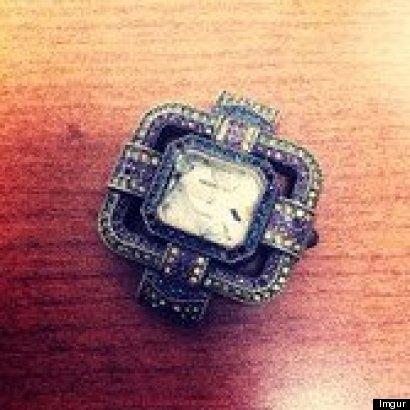
you have done what many others would not simply by being
my friend."
As Tony walked away, she started to cry. At that moment, a realization took hold.
"When you reach out and do something kind for someone less fortunate, you get back not only what you gave, but infinitely more," she wrote.
Users who commented on the thread seemed to agree, including one who said he used to be homeless.
"Every single time a 'regular person' treated me like a human being, it was refreshing and heartwarming," wrote Franco_DeMayo. "I'm glad that Tony got the chance to touch your life, as I can confidently say that it probably meant a whole lot to him to be able to give back in some way."
Click the icon below to be taken to a site in Chinese of the story:


